The 5 Biggest Mistakes in Stock Investing (And How to Avoid Them)
Entering the world of stock investing is exciting. Imagine your money working for you while your portfolio grows and brings you closer to financial freedom. However, this picture can quickly be overshadowed by several easily made but costly mistakes. Many beginner investors, driven by enthusiasm and dreams of quick profits, stumble into the same traps that turn investing into gambling.
The purpose of this article is to illuminate these traps. We will examine the five biggest mistakes in stock investing and give you specific, practical advice on how to avoid them. Because the successful path of an investor is measured not only by good hits, but also by prevented losses.
Why is it so easy to make mistakes when investing in stocks?
It's extremely easy because emotions like fear and greed, combined with the endless stream of information and misinformation, often cloud sound judgment. Successful stock investing requires discipline and rationality – two qualities that easily disappear under the pressure of market dynamics.
Every day we are bombarded with news about the "next big stock," with stories of people who got rich quickly on social media, and with complex financial analyses. This information noise creates a sense of urgency and fear of missing out (FOMO), which pushes us toward impulsive and ill-considered decisions. It is in this environment that the biggest investment mistakes are born.
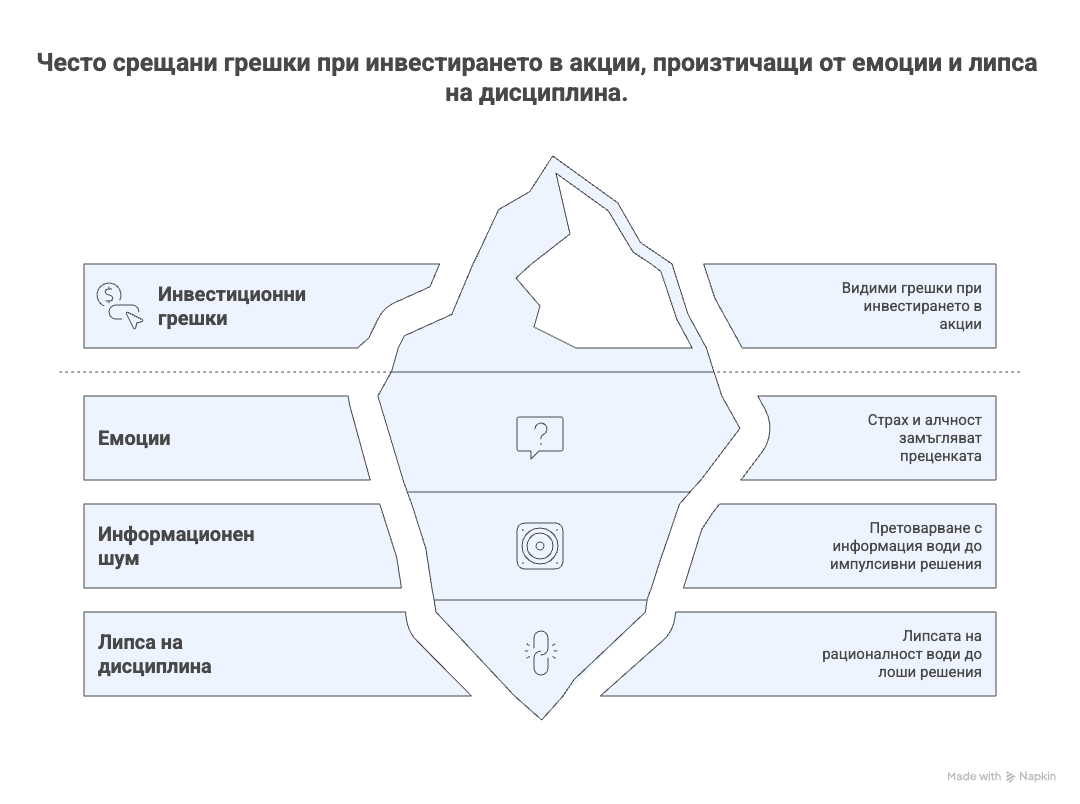
Most common mistakes in stock investing
Mistake #1: How does lack of a clear strategy sabotage your investments?
Lack of strategy causes you to make impulsive, emotional decisions instead of following a logical plan, which almost always leads to losses. Without a strategy, you are like a ship without a rudder in stormy seas – every market wave pushes you in a different direction and ultimately diverts you from your ultimate goal.
Investing without a plan is like building a house without an architectural blueprint. You might start, but the result will be chaotic, unstable, and far from what you imagined. Your investment strategy is your financial blueprint – it defines your goals, your risk tolerance, and the path you will take to achieve the desired results.
How to build your first investment strategy?
To build a strategy, you need to start by defining your personal financial goals, the time horizon for achieving them, and your level of comfort with market fluctuations. This is the foundation upon which your entire investment journey will rest.
Before we focus on the specific steps, it's important to understand that there is no universal strategy. The best strategy is one that is tailored to your individual needs and allows you to sleep peacefully at night.
- Define your goals: What are you saving for? For retirement in 30 years, for a down payment on a home in 5 years, or for your children's education;
- Define your time horizon: How much time do you have before you need the money? A long horizon allows for taking higher risk for higher returns;
- Assess your risk tolerance: How would you react if your portfolio dropped by 20%? The answer to this question will help you choose the right balance between risky and safer assets;
- Choose appropriate assets: Based on the above points, decide what you will invest in. For beginners, diversified exchange-traded funds (ETFs) are often the best start;
- Create a plan for regular contributions: Decide what amount and how often you will invest (for example, $200 every month).
After going through these steps, you will have a clear and easy-to-follow plan that will protect you from impulsive decisions.
Mistake #2: Why are emotional decisions your biggest enemy?
Emotional decisions are the investor's biggest enemy because they make you do exactly the opposite of what is logical: buy high (from fear of missing out) and sell low (from panic during a decline). The market moves in cycles, but human psychology often makes us act at the most inappropriate moment of that cycle.
Imagine the market crashing. Your heart beats faster, you see the value of your portfolio decreasing, and instinct screams: "Sell before you lose everything!" This is panic selling. Weeks later the market recovers, but you are already out of it and have realized a loss. The opposite scenario is FOMO (Fear Of Missing Out) – you buy a stock at the peak of its price, just because everyone is talking about it, shortly before its price crashes.
| Situation | Emotional Reaction (Wrong) | Rational Reaction (Right) |
|---|---|---|
| Market is rising fast | I'm buying everything now so I don't miss out! (FOMO) | I stick to my regular contribution strategy. If an asset is severely overvalued, I can skip the contribution or reduce it. |
| Market is crashing | I'm selling everything to stop the losses! (Panic) | I accept the decline as an opportunity. This is a "sale" on quality assets and I stick to my plan, I might even invest more. |
| "Hot" stock is talked about everywhere | I'm buying immediately without knowing what the company does! | I ignore the noise and do my own research. I invest only if the company fits my strategy. |
Mistake #3: How does neglecting diversification increase your risk?
Neglecting diversification is like putting all your eggs in one basket. If that basket falls (i.e., a single company you've invested everything in goes bankrupt or its sector suffers a crisis), you lose all your capital.
Diversification is a fundamental principle in risk management. It means distributing your investments across stocks of different companies, industries, and even geographical regions. This way, if one of your assets performs poorly, the loss will be compensated by the good performance of the others. This makes your portfolio much more resilient to market shocks.
How to diversify your portfolio effectively?
The easiest and most accessible way for effective diversification, especially for beginners, is through investing in exchange-traded funds (ETFs). These funds are like a basket that already contains hundreds or thousands of stocks, thus providing you with instant diversification.
For example, by buying just one share of an ETF that tracks the S&P 500 index, you are essentially investing in the 500 largest companies in the US. This is much safer than trying to pick 2-3 "winning" stocks yourself. You can diversify further by adding ETFs that track European or global markets.
Mistake #4: Why trying to "beat the market" is a doomed cause?
Attempts to "beat the market" by timing the perfect moment to buy and sell (so-called market timing) are doomed because it is practically impossible to consistently predict when the market will reach its peak or bottom. Even professional fund managers fail to do this successfully in the long term.
Many beginners lose money trying to be smarter than the market. They wait for the "perfect moment" to enter, missing periods of growth, or sell at the first sign of trouble, missing the subsequent recovery. There's an old saying in investing: "It's not about timing the market, but about time in the market."
The solution is simple and is called Dollar-Cost Averaging (DCA). Here's how it works:
Before we describe the method, you should know that it eliminates the need for forecasting. Instead, it relies on discipline and consistency.
- You invest a fixed amount of money: For example, $200;
- You do it at regular, predetermined intervals: For example, on the 5th of every month;
- You do it regardless of the asset price: You don't care if the market is "high" or "low";
- The result: When prices are low, your $200 buys more shares. When prices are high, it buys fewer. In the long term, this averages your purchase price and reduces the risk of investing a large sum at a market peak.
This method removes emotions from the process and turns market volatility from your enemy into your ally.
Mistake #5: What happens when you invest without prior research?
When you invest without research, you are not making stock investments but betting blindly. This makes you an easy victim of market noise, of "trendy" stocks without real value, and virtually guarantees you a loss in the long term.
Warren Buffett has a famous phrase: "Never invest in a business you don't understand." Before you invest even one dollar in a company, you should have at least a basic idea of what it does, how it makes money, and what its prospects are. Investing in something just because your friend told you or you saw it on TikTok is a recipe for disaster.
What are the basic things to research before investing?
To make an informed decision, you need to focus on the company's fundamentals. Research its business model, financial statements (revenue, profit, debt), and how it's valued compared to its competitors.
You don't need to be a financial analyst to do basic research. Start with answers to the following questions:
- What does the company do? Do you understand its product or service? Does it have a sustainable competitive advantage?
- Is it financially stable? Have its revenues and profits grown over the past few years? Does it have too much debt?
- Is the stock expensive? Compare its metrics like P/E (price-to-earnings ratio) with those of other companies in the same sector.
Conclusion
Avoiding these five basic mistakes – lack of strategy, emotional decisions, neglecting diversification, attempts to "beat" the market, and lack of research – is more important than finding the "winning" stock. Success in investing doesn't come from bold moves and quick profits, but from discipline, patience, consistency, and continuous learning.
The path to successful stock investing begins not with the first purchase, but with the first avoided mistake. Start building your strategy today and turn knowledge into your strongest asset.
Frequently Asked Questions (FAQ)
1. How much time should I dedicate to research?
For beginners who invest mainly in ETFs, research is minimal – you need to understand which index the fund tracks. If you want to buy stocks of individual companies, dedicate at least a few hours to familiarize yourself with the business basics before investing.
2. What is an ETF and why is it good for beginners?
An ETF (Exchange-Traded Fund) is a fund that owns a basket of many different assets (for example, stocks of 500 companies). It's ideal for beginners because it offers instant diversification and low risk for minimal fees, eliminating the need to pick individual stocks yourself.
3. Should I sell everything if the market starts falling?
No, this is classic panic selling. If you have a long-term strategy and have invested in quality, diversified assets, market declines should be viewed as temporary and even as an opportunity to buy more at lower prices.
4. What's the difference between investing and speculation?
Investing is the process of putting money into assets with the expectation of long-term growth, based on the fundamental value of the asset. Speculation is betting on short-term price movements, often regardless of fundamentals, and is significantly riskier. This article focuses on the principles of investing.