Key Takeaways
- Set clear financial goals and assess risks before investing.
- Diversify your portfolio across different asset classes - stocks, bonds, real estate, cryptocurrencies.
- The best investment strategy depends on your personal goals and risk tolerance.
- Regular monitoring and adjustment of investments is crucial for long-term success.
First Steps Toward Successful Investments
What is Investment?
Investment is the process of allocating capital into various assets with the aim of generating future profits. In the modern world, investing is an integral part of financial planning as it provides long-term financial stability and growth opportunities.
Definition of Investment
Investment involves purchasing or creating assets that have the potential to increase in value or generate passive income. These can be tangible (real estate, gold) or intangible (stocks, bonds, cryptocurrencies).
Why Is It Important to Invest?
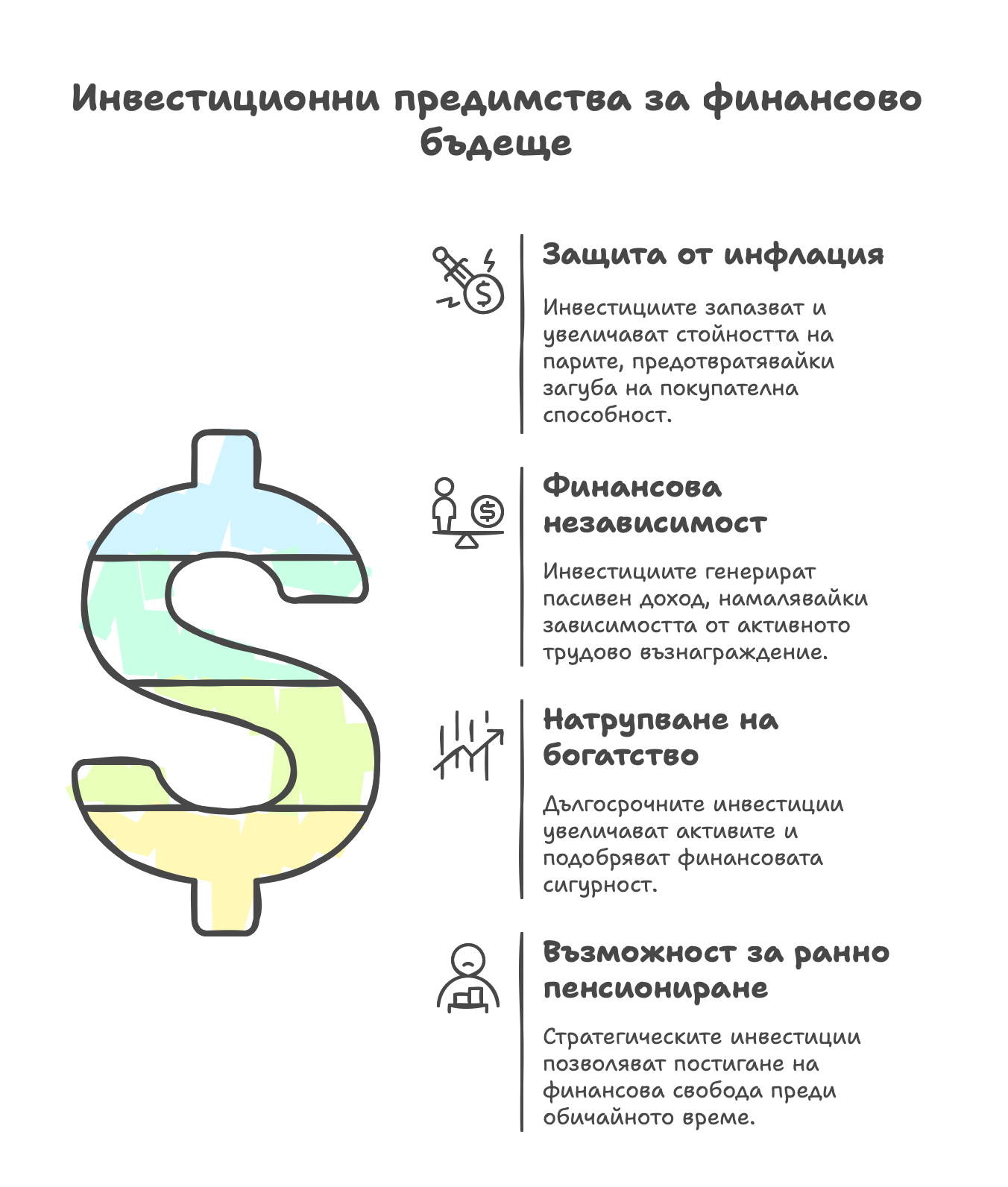
Investing is key to building a financially stable future. Its main advantages include:
- Protection against inflation - money loses value over time, while investments preserve and increase capital;
- Financial independence - the right investments create passive income that reduces dependence on salary;
- Wealth accumulation - with a long-term strategy, investing increases assets and financial security;
- Early retirement opportunity - through smart investments, financial freedom can be achieved at an earlier stage of life.
How to Approach Investments Wisely?
The right approach to investing includes the following steps:
- Defining financial goals – short-term and long-term;
- Risk assessment – different investments carry different levels of risk;
- Portfolio diversification – distributing capital across different assets minimizes losses;
- Regular monitoring and adjustments – investment strategy must adapt to market conditions.
Main Types of Investments
1. Investments in Financial Assets
Financial assets are among the most accessible and popular investment instruments. They offer a variety of profit opportunities and, depending on the strategy, can be short-term or long-term.
➤ Stocks
How do stocks work?
Stocks represent ownership stakes in a company. By buying stocks, the investor becomes a co-owner of the company and is entitled to a share of the profits as well as voting rights in decisions. The value of stocks can rise or fall depending on the company's performance and market conditions.
Dividend stocks vs. growth stocks
Stocks are primarily divided into two types:
- Dividend stocks – provide regular dividend payments, suitable for passive income;
- Growth stocks – do not pay dividends but have higher potential for capital appreciation.
How to choose the right stocks?
Choosing suitable stocks depends on several factors:
- Fundamental analysis – assessment of the company's financial condition and profitability;
- Technical analysis – analysis of charts and historical price trends;
- Risk profile – aligning with personal risk tolerance.
For this type of analysis, as well as comprehensive detailed information about a company's financial condition, data, and statistics, you can check the analytical tools on the website.
➤ Bonds
What are bonds?
Bonds are debt securities issued by government institutions or corporations. They carry fixed interest income and are considered a more stable asset compared to stocks.
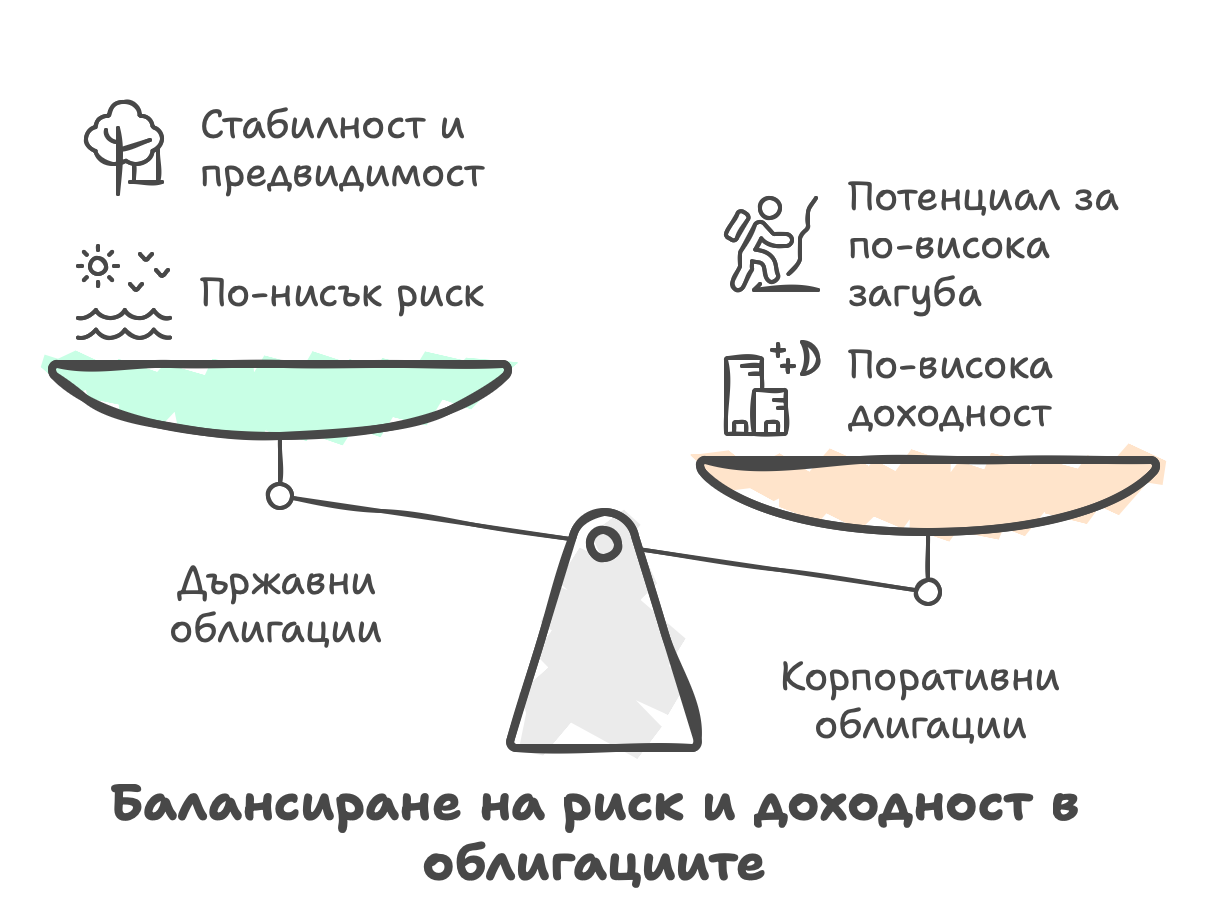
Government vs. corporate bonds
- Government bonds – issued by governments, lower risk but also lower returns;
- Corporate bonds – issued by companies, higher returns but also higher risk.
Advantages and disadvantages
Advantages:
- ✔ Stability and predictability;
- ✔ Suitable for conservative investors;
- ✔ Lower risk of capital loss.
Disadvantages:
- ✖ Lower returns compared to stocks;
- ✖ Possibility of inflationary depreciation.

➤ ETFs and Investment Funds
Difference between ETFs and mutual funds
- ETF (Exchange-Traded Fund) – trades on the exchange like stocks, with lower fees and high liquidity;
- Mutual fund – managed by professional managers, requires higher fees but provides professional management.
How to choose a suitable fund?
- Strategy analysis – whether the fund follows an index or is actively managed;
- Management expenses – lower fees increase returns;
- Historical performance – evaluating the fund's performance over the years.
Risks and benefits
Benefits:
- ✔ Portfolio diversification;
- ✔ Reduction of individual risk;
- ✔ Access to global markets.
Risks:
- ✖ Possibility of loss during market downturns;
- ✖ Some funds have high fees.
Investing is a powerful tool for achieving financial independence. It's important to understand how different types of assets function and choose a strategy that matches individual goals and risk tolerance. Whether you invest in stocks, bonds, or funds, the most important thing is to start today and build a long-term plan for financial growth.
2. Real Estate Investments: What to Invest In?
Real estate investments are one of the most popular ways for long-term wealth accumulation. They offer stability, passive income, and potential for asset appreciation. In this section, we'll look at the main types of real estate investments and how to approach them wisely.
Residential Properties
Buying for rental purposes
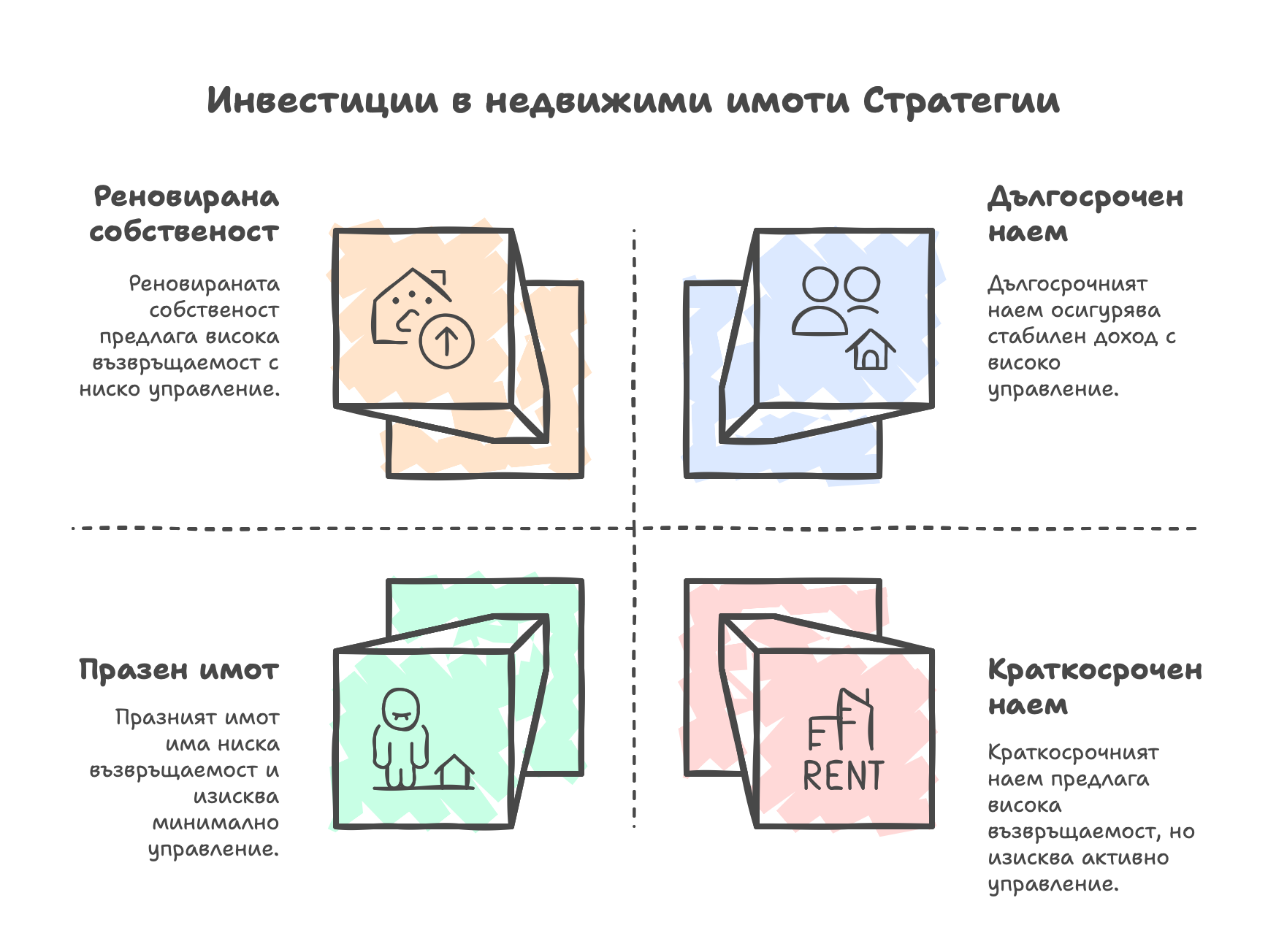
One of the most common ways to invest in real estate is purchasing a property for renting. This can be:
- Long-term rental, which provides stable income from tenants for an extended period;
- Short-term rental (Airbnb, Booking.com), which yields higher returns but requires more management and maintenance.
Advantages:
- ✔ Passive income from rent;
- ✔ Long-term stability;
- ✔ Opportunity to increase rental prices based on demand.
Risks:
- ❌ Potential problems with tenants;
- ❌ Costs for repairs and maintenance;
- ❌ Periods without tenants.
Property price growth
Real estate prices have historically increased, especially in large cities and developing areas. The main factors that influence property values include:
- Supply and demand – prices rise in areas with high demand;
- Economic environment – inflation, interest rates, and political stability play a role;
- Infrastructure projects – new metro stations, shopping centers, or business districts increase prices.
When is a good time to invest?
- During low mortgage interest rates;
- In periods of economic growth;
- In areas with planned infrastructure improvements.
Commercial Properties
Investments in offices, shops, and warehouses
Commercial properties are another way of investment that can provide high returns. They are divided into several categories:
- Offices – suitable for investment in business districts with high demand;
- Shops and retail spaces – a stable option if located in central or busy areas;
- Warehouses and logistics centers – with the growth of online commerce, this segment is seeing significant growth.
Risks and returns
- ✔ High rental income compared to residential properties;
- ✔ Long-term contracts that guarantee stable income;
- ✔ Lower competition in some segments, such as warehouses and logistics.
- ❌ Dependence on economic cycles – during recessions, businesses reduce rental expenses;
- ❌ Longer periods to find tenants compared to residential properties;
- ❌ High initial investments.
REITs (Real Estate Investment Trusts)
What are they?
REITs are companies that invest in large real estate properties and offer individual investors the opportunity to profit from them without the need for direct purchase.
Why are they an attractive investment?
- ✔ Diversification – investors get exposure to different types of properties;
- ✔ Liquidity – unlike physical properties, REITs can be bought and sold like stocks;
- ✔ Passive income – REITs distribute a large portion of their profits as dividends.
Real estate investments can be an excellent way for long-term wealth accumulation. It's important to choose the right strategy according to your financial goals and risk tolerance.
3. Cryptocurrency Investments
Cryptocurrencies are one of the most innovative and risky investment classes. They offer potential for high returns but are also subject to significant volatility and regulatory uncertainty.
Bitcoin and Altcoins
Long-term vs. short-term approach
Long-term approach ("HODL")
- Investing in stable cryptocurrencies like Bitcoin and Ethereum with the expectation that prices will increase over time.
- Requires patience and resilience to market downturns.
- Less risky compared to active trading.
Short-term approach (trading)
- Speculative trading aimed at profiting from short-term price movements.
- Includes strategies such as day trading and scalping.
- High risk but potential for quick returns.
How to choose suitable cryptocurrencies?
- Fundamental analysis – research of the project, team, technologies, and market potential.
- Technical analysis – using charts, indicators, and historical data to predict price movements.
- Risk distribution – investing in different cryptocurrencies for diversification.
Staking and Mining Cryptocurrencies
How does staking work?
Staking is a process where investors "lock" their cryptocurrencies in the blockchain network to maintain its security and receive rewards. The most popular networks for staking include Ethereum 2.0, Cardano, and Polkadot.
- ✔ Passive income without the need for hardware.
- ✔ More environmentally friendly compared to cryptocurrency mining.
- ❌ Risk of investment loss if the project is uncertain.
- ❌ Locking funds for a specific period.
Pros and cons of mining
Mining cryptocurrencies like Bitcoin involves solving complex mathematical equations using powerful computers.
- ✔ Possibility of stable income under good market conditions.
- ✔ Control over infrastructure (if managed independently).
- ❌ High initial costs for hardware and electricity.
- ❌ Competition with large mining pools.
NFTs and Blockchain Technologies
Investing in digital assets
NFTs (non-fungible tokens) represent unique digital assets that can be artwork, music, video, or virtual items in games.
- ✔ Opportunity to profit from the growing interest in digital assets.
- ✔ NFTs can provide real rights to assets and copyrighted content.
- ❌ Strong volatility and market bubbles.
- ❌ Lack of regulation and potential for fraud.
Risks and prospects
- ✔ Blockchain technologies are finding increasing application beyond cryptocurrencies (contracts, logistics, finance).
- ✔ Potential for long-term capital gains.
- ❌ High risk of regulatory changes that could affect the market.
4. Investments in Business and Entrepreneurship
Investing in business can be one of the most rewarding ways to accumulate wealth, but it also requires in-depth knowledge, strategic thinking, and high risk tolerance.
5. Investments in Precious Metals and Commodities
➜ Gold and Silver
Why is gold a "safe haven" in times of crisis?
Gold is traditionally considered a "safe haven" during economic and geopolitical crises. The main reasons include:
- Limited supply – gold cannot be printed or artificially created, making it a valuable asset.
- Protection against inflation – when currencies lose value, gold maintains its purchasing power.
- Globally recognized asset – can be easily exchanged anywhere in the world.
- Historical resilience – throughout the centuries, gold has maintained its status as a valuable resource.
How to invest in precious metals?
- Physical gold and silver – investment in bars, coins, and jewelry.
- Funds (ETFs) – funds based on the value of gold and silver.
- Mining company stocks – investment in companies that extract precious metals.
- Futures and options contracts – derivative instruments for more experienced investors.
- Digital gold – the ability to purchase gold from a refinery that is not delivered to us except upon request.
➜ Oil and Natural Gas
Commodity market volatility
Investments in oil and natural gas are associated with high volatility due to:
- Geopolitical conflicts.
- Changes in production and supply.
- Fluctuations in global demand.
- Regulatory changes and environmental factors.
Long-term potential
Despite the transition to green energy, fossil fuels still play a key role in the global economy.
Diversification through investments in green energy and energy storage technologies can balance the risk.
➜ Agricultural Assets (land, crops, water resources)
How to invest in agriculture?
- Purchase of arable land.
- Investing in agribusiness companies.
- Participation in agricultural funds and ETFs.
Risks and opportunities
- Opportunities: growing world population increases demand for food.
- Risks: natural disasters, climate change, and regulations.
6. Alternative Investments
➜ Wine, Art, and Collectibles
Long-term profit potential
High-yield niche for investors with good knowledge.
The price of rare wines, paintings, and antiques often increases over time.
How to assess the value of assets?
- Consultation with experts and appraisers.
- Analysis of historical prices and market trends.
- Investing in certified and verified items.
➜ P2P Lending and Loan Platforms
How do P2P investments work?
Investors provide funds to individuals or businesses through peer-to-peer lending platforms.
Funds are distributed among multiple loans to reduce risk.
Returns and risks
- Returns: possibility of higher interest rates compared to traditional deposits.
- Risks: borrower insolvency, regulatory changes.
➜ Investing in Patents and Intellectual Property
How to profit from patents?
- Licensing patents for royalty fees.
- Sale of patent rights.
- Investing in companies with rich patent portfolios.
Licensing and copyrights
- Development of innovative products and services.
- Protection of intellectual property through patent registrations.
- Monetization through partnerships with industry players.
How to Choose the Right Investment for Us?
Risk and Return Assessment
When choosing an investment, it's important to assess the potential return and level of risk. Investors should consider market conditions and their personal risk tolerance.
Short-term vs. Long-term Investments
- Short-term investments – bring quick returns but are often associated with higher risk.
- Long-term investments – provide more stable growth and lower risk over time.
Portfolio Diversification
Allocating funds across different assets helps reduce risk and increase chances for stable income.
Frequently Asked Questions
Which investment yields the highest return? There is no universal answer as each investment has different levels of risk and return. Historically, stocks and real estate offer high returns in the long run.
How do I start with a small amount? Start with low-risk investments like ETFs, P2P loans, or mutual funds that allow flexibility and minimal initial investments.
How long does it take to see results? It depends on the type of investment – stocks and real estate typically require years, while cryptocurrencies and P2P loans can bring results within a few months.
Conclusion
The Best Investment Opportunities for 2025
The coming year offers a wide range of investment opportunities, including financial assets, real estate, cryptocurrencies, business ventures, and alternative investments.
Tips for a Successful Investment Plan
- Define clear financial goals.
- Assess risks and opportunities.
- Diversify your portfolio.
- Monitor market trends.
Long-Term Approach to Financial Independence
Regardless of the type of investment chosen, the key to success is consistency and a long-term strategy. Investing requires patience, knowledge, and adaptability to changing market conditions.
About the Author

Pavlin Marinov
Pavlin Marinov is part of the Trading Toolbox team, specializing in investment analysis and financial news. With years of experience in finance and investments, he strives to provide in-depth analyses and current market commentary. Through his publications and participation, he contributes to increasing financial literacy and awareness among the audience.
Verified by

Gerasim Tsonev
Computer Science graduate from the University of Southampton with a passion for Finance. As the Lead Developer and CEO of Trading Toolbox, Gerasim ensures the accuracy and reliability of all published content.