ETF Investing: The "Boring" Method That Can Make You Rich
Imagine being able to own a small piece of hundreds of the world's largest and most successful companies with a single, easy purchase. Imagine an investment strategy that doesn't require you to monitor markets daily, analyze complex financial statements, or try to predict the next big hit on Wall Street. This approach not only exists but is more accessible than ever for investors in Bulgaria. Welcome to the world of ETF investing (Exchange-Traded Funds) – the financial instrument that has revolutionized how millions of people around the world build their wealth. While some call it "boring" due to its passive nature, it's precisely in this simplicity that its genius and power lie. This article will be your guide to the world of ETF investing, revealing everything you need to know to start your journey toward financial independence.
What Exactly is an ETF (Exchange-Traded Fund)?
The answer to this question is quite simple: an ETF, or Exchange-Traded Fund, is an investment product that contains a basket of many different assets (such as stocks, bonds, or commodities) and trades on the stock exchange like a single stock. This basic concept makes ETF investing so easy to understand and accessible.
When you buy one share of an ETF, you're essentially buying miniature pieces of all the assets contained within it. For example, if you purchase an ETF that tracks the American S&P 500 index, you instantly become an owner of a small part of 500 of the largest companies in the US, including Apple, Microsoft, Amazon, and many others. This allows you to participate in the success of the entire market rather than trying to guess which individual company will perform best.
Why is ETF Investing So Popular Among Beginners (and Not Only)?
The popularity of ETF investing is due to the unique combination of advantages they offer, making them suitable for both beginners and advanced investors. They solve many of the fundamental problems people face when trying to invest in the stock market.
These advantages make exchange-traded funds the preferred tool for long-term wealth building. Let's examine the most important ones.
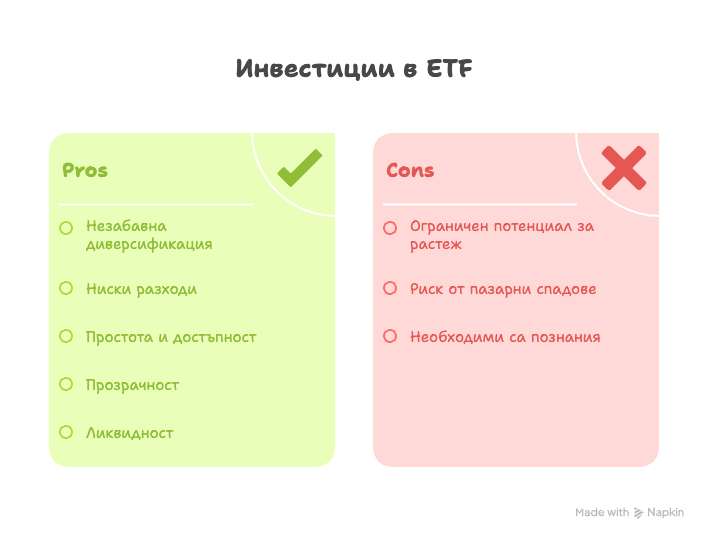
1. Instant and Easy Diversification:
Perhaps the greatest advantage of ETF investing is that with one transaction, you spread your risk across dozens, hundreds, or even thousands of different companies, industries, and countries. Instead of risking your money on the success of a single company, you're betting on the growth of the entire market or sector, which significantly reduces the risk of large losses if one or several companies perform poorly.
2. Low Costs and Fees:
Most ETFs, especially those that track market indices, are passively managed. This means that management costs (the so-called "expense ratio") are extremely low – often under 0.20% annually, and sometimes even under 0.10%. Compared to actively managed mutual funds, where fees can be 1-2% or more, the low costs of ETFs have a huge positive effect on your returns in the long term.
3. Simplicity and Accessibility:
The process of ETF investing is as easy as buying a stock of any company. You can buy and sell them at any time during the trading day through your investment broker. There are no complex procedures or high minimum investment requirements, making them accessible to absolutely everyone.
4. Transparency:
The composition of every ETF is publicly known, and you can check at any time exactly which companies or assets it invests in. This complete transparency gives you security and clarity about what exactly you own, unlike some more opaque financial products.
5. Liquidity:
Since ETFs trade on major stock exchanges, they are usually very liquid. This means you can easily buy or sell them at their current market price at any time during the exchange's trading day.
These five key advantages make ETF investing an intelligent, efficient, and accessible way to participate in financial markets.
What are the Main Types of ETFs You Can Invest In?
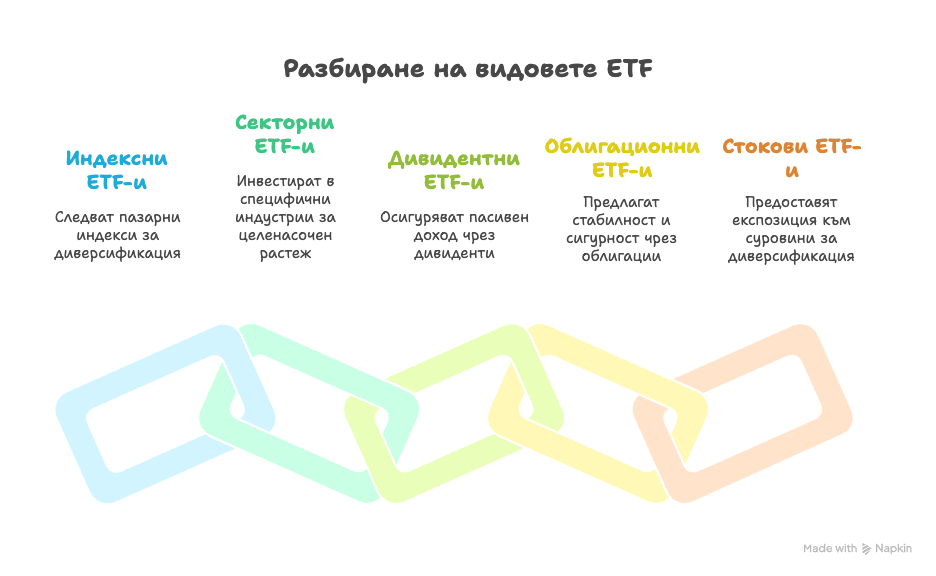
Yes, there's a huge variety of exchange-traded funds that allow investors to target different markets, sectors, and investment strategies. Understanding the main types will help you build a diversified portfolio that matches your goals and risk tolerance.
Index ETFs: The Most Popular Choice?
Yes, this is definitely the most popular and recommended type for most investors. These ETFs track the performance of major market indices, such as the S&P 500 (the 500 largest American companies), NASDAQ 100 (the 100 largest technology companies in the US), or MSCI World (large companies from the entire developed world). ETF investing that follows broad market indices is the foundation of every well-diversified portfolio.
Sector ETFs: How to Bet on a Specific Industry?
These funds allow you to invest in a basket of companies from a specific economic sector. If you believe in the future of a particular industry but don't want to choose a single company, this is a great way to make targeted investments in technology, healthcare, financial services, energy, consumer goods, and others.
Dividend ETFs: For Those Seeking Passive Income?
Yes, exactly. These ETFs invest in a basket of stocks from companies known for regularly paying dividends to their shareholders. ETF investing of this type is suitable for investors seeking not only capital growth but also regular passive income from their investments.
Bond ETFs: How to Add Security to the Portfolio?
These ETFs don't invest in stocks but in bonds – government or corporate. Bonds are considered less risky assets compared to stocks and are often used to balance an investment portfolio. They can provide stability and more predictable income, especially during market uncertainty.
Commodity ETFs: Opportunity to Invest in Gold, Oil, and Others?
Yes, these funds allow investors to gain exposure to commodity markets like gold, silver, oil, natural gas, or agricultural products without having to physically buy and store them. ETF investing of this type can be a good diversification tool and protection against inflation.
What's the Difference Between ETF and Mutual Fund?
This is a frequently asked question since both products offer diversification. The main difference lies in the trading method, management, and costs, which makes ETF investing more flexible and accessible for the average investor.
Understanding these key differences will help you make a better choice for your goals. Here's a comparison table that clearly shows the advantages of ETF investing:
| Criteria | ETF (Exchange-Traded Fund) | Mutual Fund |
|---|---|---|
| Trading Method | Trades on the exchange throughout the day like a stock. Price changes constantly. | Bought and sold only once a day, after the end of the trading day, at net asset value (NAV). |
| Management | Predominantly passive (follows an index). There are actively managed ones, but they're fewer. | Predominantly actively managed by a portfolio manager who tries to "beat" the market. |
| Costs (Fees) | Usually very low annual management fees (expense ratio), often under 0.20%. | Significantly higher management fees, often over 1-2%, plus possible entry and exit fees. |
| Transparency | Full transparency. Fund composition is publicly known and updated daily. | Less transparency. Portfolio composition is usually announced quarterly. |
| Minimum Investment | You can buy even one share (or part of one), making the initial investment very low. | Often has higher minimum initial investment requirements (e.g., several thousand dollars). |
This table clearly shows why ETF investing has become the preferred tool for millions of investors worldwide due to its efficiency and accessibility.
How to Make Your First ETF Investments from Bulgaria Step by Step?
The process of starting ETF investing from Bulgaria has been significantly simplified in recent years. Here are the main steps you need to go through to make your first informed investment.
Step 1: How to Choose a Suitable Broker?
This is the first and most important step. You need to open an account with a licensed investment intermediary (broker) that offers access to international stock exchanges (such as those in the US and Europe). Research several brokers available to Bulgarian citizens and compare their trading and maintenance fees, ease of use of the platform, and their regulation.
Step 2: What are the Key Terms We Need to Know (UCITS, Accumulating/Distributing)?
For investors from Bulgaria and Europe, it's extremely important to understand these two terms:
UCITS: Look for ETFs that have "UCITS" in their name. This is an EU regulatory framework that ensures a high degree of protection for investors.
Accumulating vs. Distributing: Distributing ETFs pay dividends directly to your account. Accumulating ETFs automatically reinvest dividends back into the fund, which is more convenient and often more advantageous from a tax perspective for long-term investors.
Step 3: How to Choose a Specific ETF That Matches Our Goals?
After you have a broker, you need to choose what exactly to invest in. For most beginners, a good start is an ETF that tracks a broad global index like MSCI World or FTSE All-World (which includes emerging markets), or the American S&P 500. These funds provide maximum diversification. Use sites like justETF.com or morningstar.com to filter and compare different ETFs.
Step 4: How to Make Our First Purchase and Build a Strategy?
After you've chosen an ETF, the buying process through the broker's platform is easy. It's important to have a strategy. One of the best strategies for long-term ETF investing is "dollar-cost averaging" – investing a fixed amount of money at regular intervals (e.g., every month), regardless of market movements. This reduces the risk of bad timing.
What are the Potential Risks in ETF Investing?
Yes, ETF investing is less risky than choosing individual stocks, but it's important to know that they're not completely risk-free. The main risk is market risk – if the entire market (e.g., S&P 500) crashes, the value of your ETF will also fall. Other risks include tracking error, where the ETF doesn't perfectly follow its index, and liquidity risk with more exotic and niche ETFs that may be harder to sell.
Frequently Asked Questions About ETF Investing (FAQ)
When we enter the world of exchange-traded funds, many questions arise. Here are answers to some of the most common ones.
What is the Minimum Amount for ETF Investment?
The minimum amount is the price of one share of your chosen ETF. However, many brokers offer "fractional shares," which allows you to start with very small amounts like 20, 50, or 100 leva. This makes ETF investing accessible to absolutely everyone.
Do ETFs Pay Dividends?
Yes, they do. As we explained, there are two main types: distributing, which pay dividends directly to your account, and accumulating, which automatically reinvest them back into the fund, increasing the value of your shares. For long-term investors from Bulgaria, accumulating ETFs are often the more convenient and tax-efficient choice.
How Often Should I Invest in ETFs?
The best strategy for most people is to invest regularly and consistently, for example, every month. This approach is called "dollar-cost averaging" and reduces the risk of investing a large sum at an inappropriate time. Consistency is more important than trying to "time" the market.
How are ETF Profits Taxed in Bulgaria?
For Bulgarian individuals, capital gains from selling shares and ETFs traded on regulated EU/EEA markets are exempt from tax. This is a huge advantage for investors in Bulgaria. It's important to choose ETFs registered in an EU country (e.g., Ireland or Luxembourg) that have "UCITS" in their name. However, tax legislation can change, so it's always good to consult with a tax expert.
Can I Lose Money from ETF Investments?
Yes, it's possible. The value of ETF investments that track stocks changes daily along with the market. In the short term, significant declines are possible. However, in the long term (10+ years), broad market indices have historically always shown growth. Investing is a marathon, not a sprint.
What Does "UCITS ETF" Mean and Why is it Important for Me?
"UCITS" is a European Union regulatory framework that ensures a high degree of protection for individual investors. It imposes strict rules on funds regarding diversification, liquidity, and risk management. For investors from Bulgaria, it's highly recommended to choose only UCITS ETFs as they offer greater security and tax advantages.
Do I Need a Financial Advisor to Invest in ETFs?
It's not mandatory. One of the greatest beauties of ETF investing is that it allows ordinary people to build a well-diversified portfolio independently, with very low costs. However, if you feel uncertain or have a more complex financial situation, consulting with a licensed financial advisor is always a good idea.
Conclusion: ETF Investing – Your Accessible Ticket to Financial Markets
ETF investing has changed the world of finance by making long-term, diversified investing accessible, easy, and cheap for millions of people worldwide, including in Bulgaria. They offer an elegant solution to many of the challenges facing beginning investors – eliminating the need to choose individual stocks, reducing risk, and minimizing costs. Imagine how with a few clicks you become an owner of a small part of the most innovative and successful companies in the world and how your money starts working for you.
Don't let fear or the feeling of complexity stop you. The path to building financial well-being starts with education and the first small step. Start educating yourself about the world of ETF investing today, through your investment assistant - Trading Toolbox, choose a suitable broker, and make your first, even if small, investment. Your future will thank you!
About the Author

Pavlin Marinov
Pavlin Marinov is part of the Trading Toolbox team, specializing in investment analysis and financial news. With years of experience in finance and investments, he strives to provide in-depth analyses and current market commentary. Through his publications and participation, he contributes to increasing financial literacy and awareness among the audience.
Verified by

Gerasim Tsonev
Computer Science graduate from the University of Southampton with a passion for Finance. As the Lead Developer and CEO of Trading Toolbox, Gerasim ensures the accuracy and reliability of all published content.