How to Perform Financial Analysis of Stocks Like Warren Buffett
When we hear the name Warren Buffett, an image of wisdom, patience, and phenomenal investment success comes to mind. Often called the "Oracle of Omaha," he has transformed his company Berkshire Hathaway into a conglomerate worth hundreds of billions of dollars. But what is his secret? Magic? Inside information? Actually, his success is rooted in a disciplined and consistent approach whose core is in-depth financial analysis of stocks. Unlike speculators who follow daily market fluctuations, Buffett views stocks not as flashing symbols on a screen, but as ownership in a real business.
In this article, we will peek behind the curtain and break down into accessible steps the methodology that Buffett uses. You will understand that you don't need to be a Wall Street genius to apply his principles. You need the right mindset, patience, and a desire to understand the business in which you are investing your money. This method is known as fundamental analysis – the art of determining the true value of a company.
Why is Fundamental Financial Analysis of Stocks So Important to Buffett?
Fundamental analysis is crucial to Buffett because he doesn't simply buy stocks, he acquires part of a business. This approach requires deep understanding of the company, its financial foundations, and long-term potential, not just speculation with the stock price. He views investing as a partnership in a given company for years ahead.
Imagine that you are buying not one stock, but the entire neighborhood store. You wouldn't make a decision based solely on rumors or because "the price is going up." You would want to know how many customers it has, what the revenues and expenses are, whether there is strong competition, and whether the manager is honest and capable. That's exactly what Buffett does, but on a much larger scale. His goal is to calculate the "intrinsic value" of the business and buy it when the market offers it at a price significantly lower than that value.
What are the Four Pillars in Buffett's Investment Philosophy?
The four main pillars of his philosophy are: understanding the business, having sustainable competitive advantage, competent and honest management, and purchasing at a reasonable price. These principles form the solid framework upon which every one of his financial stock analyses and investment decisions is built. They work in synergy to reduce risk and increase the probability of long-term returns.
How to Understand the Business We're Investing In?
To understand the business, you need to focus on industries and companies whose products, services, and business model you know and understand. Buffett calls this concept the "circle of competence." He argues that you don't need to be an expert in everything, but you should know where the boundaries of your own knowledge are and stick to them.
This is why for years he avoided technology companies at the beginning of the dot-com bubble – he simply didn't understand how they made money. On the other hand, he understands excellently the business of Coca-Cola (a product that billions of people consume), American Express (payments and trust), or See's Candies (loyal customer base and pricing power). Start with industries that are familiar to you from daily life or professional experience. Read companies' annual reports, analyze their competitors, and try to answer the simple question: "How exactly does this company make money and will it continue to do so in 10 years?"
What is an "Economic Moat" and How to Discover It?
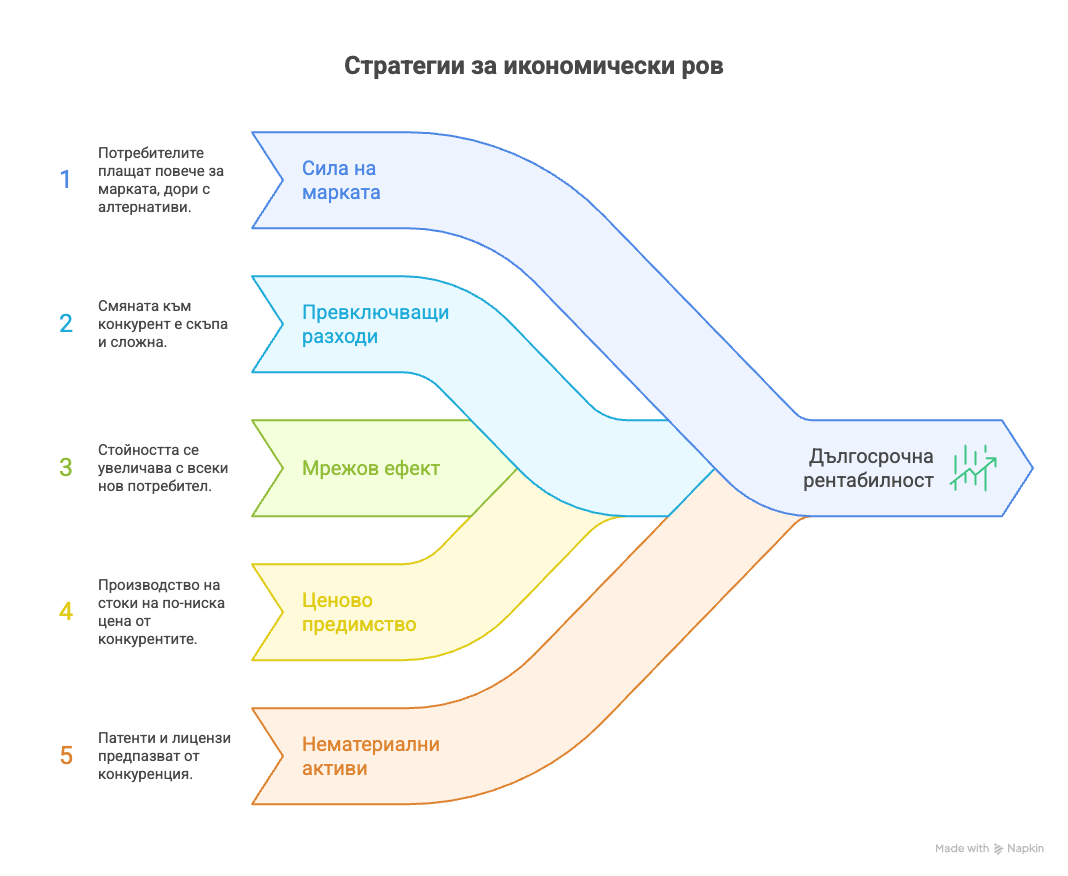
An "economic moat" is a lasting competitive advantage that protects the company and its profits from competitive attacks, similar to a moat filled with water around a medieval castle. Discovering companies with a wide and deep "moat" is a key part of evaluating their long-term profitability and is a cornerstone of Buffett's strategy.
These advantages allow the company to maintain high return on capital for a long period of time. Buffett seeks exactly such "castles" that are almost impregnable.
Here are several basic types of "economic moats" you can look for:
Brand Power: When consumers are willing to pay more for a given product because of its name, even if there are cheaper alternatives. An example of this is loyalty to Apple products or the recognizability of Coca-Cola;
Switching Costs: When it's too expensive, complex, or risky for the customer to switch to a competitor's product. Think of banks or companies like Microsoft, whose operating system is deeply integrated into business processes;
Network Effect: When the value of the product or service increases with every new user. Classic examples are social networks like Facebook (Meta) or payment systems like Visa and Mastercard;
Cost Advantage: The company's ability to produce or deliver goods and services at significantly lower cost than its competitors, allowing it to gain market share or have higher margins. Walmart is a perfect example;
Intangible Assets: This includes patents, licenses, and regulatory approvals that legally protect the company from competition. Pharmaceutical companies with patented drugs are a bright example.
Look for evidence of these "moats" in annual reports, investor presentations, and industry analyses. The presence of one or more such moats is a strong indicator of a quality business.
Why is Management Evaluation Critical?

Management evaluation is critical because even the best business with the widest "economic moat" can be destroyed by incompetent or dishonest leadership. Buffett seeks management teams that are simultaneously rational, capable, and act honestly in the interest of shareholders, not just in their own interest. He calls them partners.
How to evaluate management? First, read the annual letters to shareholders. There, company leaders discuss successes and failures. Are they frank about their mistakes? Second, analyze how they allocate the company's capital. Do they reinvest profits in high-return projects, buy back shares when they are undervalued, or pay dividends? Or do they waste money on expensive and meaningless acquisitions? Third, check their experience and reputation. Good management thinks about the next decade, not just the next quarter.
How to Determine If the Stock Price is Reasonable?
To determine if the price is reasonable, you need to compare the current market price of the stock with your assessment of its "intrinsic value." Buffett categorically insists on buying with a large "margin of safety," which means paying a price that is significantly lower than this calculated value.
This "margin of safety" is your protection against errors in analysis or unexpected bad events. If you have calculated that the true value of a stock is $100, you might decide to buy it only if its price falls to $60 or $70. This gives you a buffer. Calculating exact intrinsic value is difficult, but even an approximate assessment is better than none. For this purpose, methods like discounting future cash flows (DCF) are used, but for a start, you can compare current indicators like the price/earnings ratio (P/E) with its historical levels for the same company.
What are the Key Financial Metrics that Buffett Analyzes?
Buffett focuses on financial metrics that reveal the real profitability, efficiency, and financial stability of the company, not on short-term market sentiment. He wants to see evidence of a quality business directly in the numbers from financial statements – the income statement, balance sheet, and cash flow statement.
These metrics help him answer questions like: "How profitable is this business?", "Is it well managed?", and "Can it withstand an economic storm?"
To facilitate understanding, we have gathered the most important ones in the following table:
| Metric | What does it show? | Why is it important to Buffett? |
|---|---|---|
| Return on Equity (ROE) | How efficiently the company uses shareholders' money to generate profit. | Buffett seeks companies with consistently high ROE (often above 15%), which is a clear sign of a strong business model and competitive advantage; |
| Debt-to-Equity Ratio | Shows what portion of the company's financing comes from debt versus equity. | Buffett avoids companies with high or growing debt, as they are riskier and more vulnerable, especially during economic downturns; |
| Profit Margins | The percentage of revenue that turns into profit (gross, operating, net). | Consistent and high margins compared to competitors show pricing power and efficient cost control – a sure sign of an "economic moat"; |
| Free Cash Flow (FCF) | The money that remains with the company after covering all its operating expenses and capital investments. | This is the real, living money that management can use for dividends, share buybacks, or new investments. Buffett calls it "owner earnings"; |
| Earnings Per Share (EPS) | The portion of the company's profit allocated for each individual share. | Buffett seeks companies with a long history of consistent and predictable earnings per share growth, showing a growing and healthy business. |
Analyzing these indicators dynamically over the last 5 to 10 years gives a much clearer picture of the quality and sustainability of the business than a momentary snapshot.
How to Apply All This in Practice: Step by Step?
The practical application of Buffett's strategy begins with creating a list of potential companies from your "circle of competence." Then you move to systematically gathering financial reports and methodical analysis of each of the four pillars and key indicators we reviewed. This is a process that requires time and effort, but gives you confidence in decisions.
Think of it as detective work. You gather clues from different sources to assemble the complete picture of the "suspect" company.
Here is a simplified action plan:
Step 1: Create a watchlist. The first step is to identify companies that potentially meet the criteria for quality business. Instead of relying on chance, you can use modern tools to speed up the process. For example, with the help of a stock screener, you can filter thousands of public companies by specific financial metrics that are important to Buffett – like return on equity (ROE) above 15%, low debt/capital ratio, or stable revenue growth. This allows you to focus on industries you understand (the "circle of competence") and directly compare financial ratios of different companies to discover those that stand out. The goal is to compile an initial list of 5-10 promising "candidates" that deserve more in-depth analysis.
Step 2: Read annual reports (10-K for US companies). Don't skip the CEO's letter to shareholders and the "Management Discussion and Analysis" (MD&A) section. They often contain invaluable information;
Step 3: Analyze financial statements for the last 5-10 years. Look for stable and growing trends in revenues, profits, ROE, FCF, and low debt levels. Consistency is key;
Step 4: Evaluate the "economic moat" and management quality. Ask yourself the tough questions: Why is this company successful? Will it be successful in 10 years? Can I trust the leadership?;
Step 5: Make an approximate assessment of intrinsic value. It doesn't need to be perfect. Use simple methods like comparing the P/E ratio with its historical level or with the industry average;
Step 6: Be patient and wait for the right price. The hardest part is doing nothing. Buy only when the market offers you the company with a large "margin of safety." As Buffett says: "The stock market is designed to transfer money from the active to the patient."
This systematic approach transforms investing from gambling into an informed and thoughtful process.
Conclusion
Performing financial analysis of stocks according to Warren Buffett's methodology is a marathon, not a sprint. This is a philosophy that requires discipline, curiosity, patience, and most importantly – thinking like a business owner, not a speculator. Instead of succumbing to market noise and daily fears, you focus on what truly matters: the quality of the business and the price you pay for it.
Imagine the confidence with which you will make investment decisions when they are based on your own research and understanding, not on hot tips. Start with one company you know well. Read its latest annual report. This could be the first step on the path to more conscious and successful investing. The path is long, but the rewards for those who walk it with patience and reason can be enormous.
Frequently Asked Questions (FAQ)
1. Do I need to be a finance expert to do such analysis?
It's not mandatory to be a financial expert or accountant, but basic accounting knowledge and a strong desire to learn are needed. Buffett himself says that successful investing doesn't require advanced mathematics, but rather the right emotional attitude, business sense, and the ability to think clearly.
2. How long does a complete financial analysis of a stock take?
The duration of analysis depends heavily on your experience and the complexity of the company. Initially, researching one company may take several days or even weeks. With accumulated practice, however, the process speeds up significantly, reaching even under 5 minutes once you know what to look for in a company. The key is in the quality of analysis, not the speed of execution.
3. Does Buffett use technical analysis?
No, Warren Buffett is entirely focused on fundamental analysis. He is interested in the intrinsic value of the business, its long-term prospects, and management quality. Technical analysis, which studies price charts and market patterns, is completely outside his investment philosophy.
4. Where can I find companies' financial reports?
Financial reports are public information and are available from multiple sources. Finding them is a key first step in any financial analysis. Here are the main places where you can look for them:
The company's official website: This is the most reliable and primary source of information. Look for a section like "Investor Relations," "For Investors," or "IR." There companies publish their annual (Form 10-K for US companies) and quarterly (10-Q) reports, as well as investor presentations.
Specialized financial platforms: Modern tools like Trading Toolbox collect, process, and present financial data in an intuitive and easy-to-understand way. On such platforms, you can quickly access financial statements (income statement, balance sheet, cash flow) for the last several years, along with key ratios and visual charts that drastically facilitate comparative analysis.
Large international portals: Sites like Yahoo Finance, Morningstar, and Google Finance offer free access to financial information for thousands of companies worldwide. They are an excellent resource for quick reference and review of basic financial metrics.
Regulatory and local databases:
• For US companies, the official archive is the EDGAR database of the Securities and Exchange Commission (SEC).
• For Bulgarian public companies, the official media for disseminating regulated information is X3news. All reports and important announcements are published there.
• For all Bulgarian companies (public and private), annual financial reports are announced in the Commercial Register of the Registry Agency.
About the Author

Pavlin Marinov
Pavlin Marinov is part of the Trading Toolbox team, specialized in investment analysis and financial news. With years of experience in finance and investments, he strives to provide in-depth analysis and current market commentary. Through his publications and participation, he contributes to increasing financial literacy and awareness among the audience.
Verified by

Gerasim Tsonev
Graduated in Computer Science from the University of Southampton with a passion for finance. As Lead Developer and CEO of Trading Toolbox, Gerasim ensures the accuracy and reliability of all published content.