Investing in Stocks: The Key Warren Buffett Principles Everyone Should Know
Key Takeaways
- Invest only in companies you understand (circle of competence).
- Look for sustainable competitive advantages (economic moat).
- Buy stocks with a margin of safety.
- Focus on long-term investments.
- Evaluate the quality of management.
Investing in stocks can seem like a complex maze, especially for beginners. But what if we told you there are time-tested principles that can guide you to success? Warren Buffett, known as the "Oracle of Omaha," is one of the most successful investors of all time. His philosophy of investing in stocks is not based on complex algorithms or short-term speculation, but on common sense, patience, and a deep understanding of business. In this article, we explore Buffett's core principles that have helped millions navigate the stock market and achieve financial independence. Imagine your confidence growing as you absorb the wisdom of a true investing legend.
Who is Warren Buffett and why are his stock investing tips so valuable?
Warren Buffett is the chairman and CEO of Berkshire Hathaway – a conglomerate owning a wide range of businesses. Starting his investment career with very modest means, he has amassed a fortune of over $100 billion, primarily through smart stock investing. His strategy focuses on long-term value, not short-term market fluctuations. This consistency and proven results over decades make his stock investing advice invaluable. He doesn't follow the crowd, but relies on his own analysis based on fundamental business metrics.
Buffett is famous for his "value investing" approach, inherited from his mentor Benjamin Graham. This philosophy centers on identifying undervalued companies with strong growth potential.
What are Buffett's fundamental principles for investing in stocks?
Buffett's philosophy for investing in stocks is deceptively simple, but requires discipline and patience. It revolves around several key ideas that have stood the test of time and market cycles. Let's take a closer look at these foundational principles.
1. Invest only in what you understand (Circle of Competence) and how this relates to your stock investing.
One of Buffett's most important tips is to invest in businesses whose operations and revenues you can easily understand. This is his famous "circle of competence." If you can't explain how a company makes money, you probably shouldn't invest in its stock. When investing in stocks, it's critical to know the industry, competitive landscape, and potential risks for the company. You don't have to be an expert in everything, but you must be an expert in what you invest in.
For example, if you've worked for years in the tech sector, you probably understand software business models better than those of pharmaceutical giants. Sticking to your circle of competence reduces the risk of mistakes caused by misunderstanding when investing in stocks.

2. Look for companies with a sustainable competitive advantage (Economic Moat) – the key to successful stock investing.
Buffett loves companies with an "economic moat" – a lasting competitive advantage that protects them from rivals, like a moat around a castle. This moat can be a strong brand, patents, network effects, low production costs, or regulatory advantages. Companies with a wide economic moat are more likely to generate stable profits in the long run, making them excellent candidates for stock investing.
Recognizing these "economic moats" is a crucial part of stock analysis. These advantages allow companies to maintain profitability and defend against competition.
Here are some examples of economic moat sources:
- Brand Power: Companies like Coca-Cola or Apple have extremely strong brands, allowing them to charge higher prices and maintain customer loyalty;
- Switching Costs: When it's expensive or inconvenient for customers to switch to a competitor, this creates an advantage. Examples include banks or software platforms;
- Network Effect: The more people use a product or service, the more valuable it becomes. Social networks like Facebook are classic examples;
- Cost Advantages: The ability to produce goods or services at a lower cost than competitors, for example through scale or better processes, as with Walmart;
- Intangible Assets: Patents, licenses, or regulatory approvals that prevent competitors from entering the market. Pharmaceutical companies often rely on patents.
These advantages are not eternal, but companies that consistently maintain and expand them are favored by Buffett.
3. The "Margin of Safety" principle in the context of stock investing.
This is a cornerstone of the value investing strategy. The margin of safety is the difference between a company's intrinsic value and the price at which its shares trade. Buffett aims to buy stocks significantly below their real value. This provides a "cushion" against unexpected negative events or analytical errors. The greater the margin of safety, the lower the risk and the higher the potential profit when investing in stocks.
Calculating intrinsic value is subjective and requires careful analysis of financial statements, future prospects, and management quality. But seeking this margin is fundamental to capital protection in stock investing.
4. Long-term stock investing: Why does Buffett prefer to "hold forever"?
Warren Buffett has said: "Our favorite holding period is forever." This highlights his focus on long-term stock investing. He doesn't care about short-term market swings. Instead, he invests in companies he believes will thrive for decades. This approach allows the magic of compound interest to work and reduces the influence of emotions on investment decisions. True wealth in stock investing is often built over time, not through quick trades.
Imagine planting a tree. You wouldn't expect it to bear fruit the next day. Likewise, successful stock investing requires time for the business to grow and generate value.
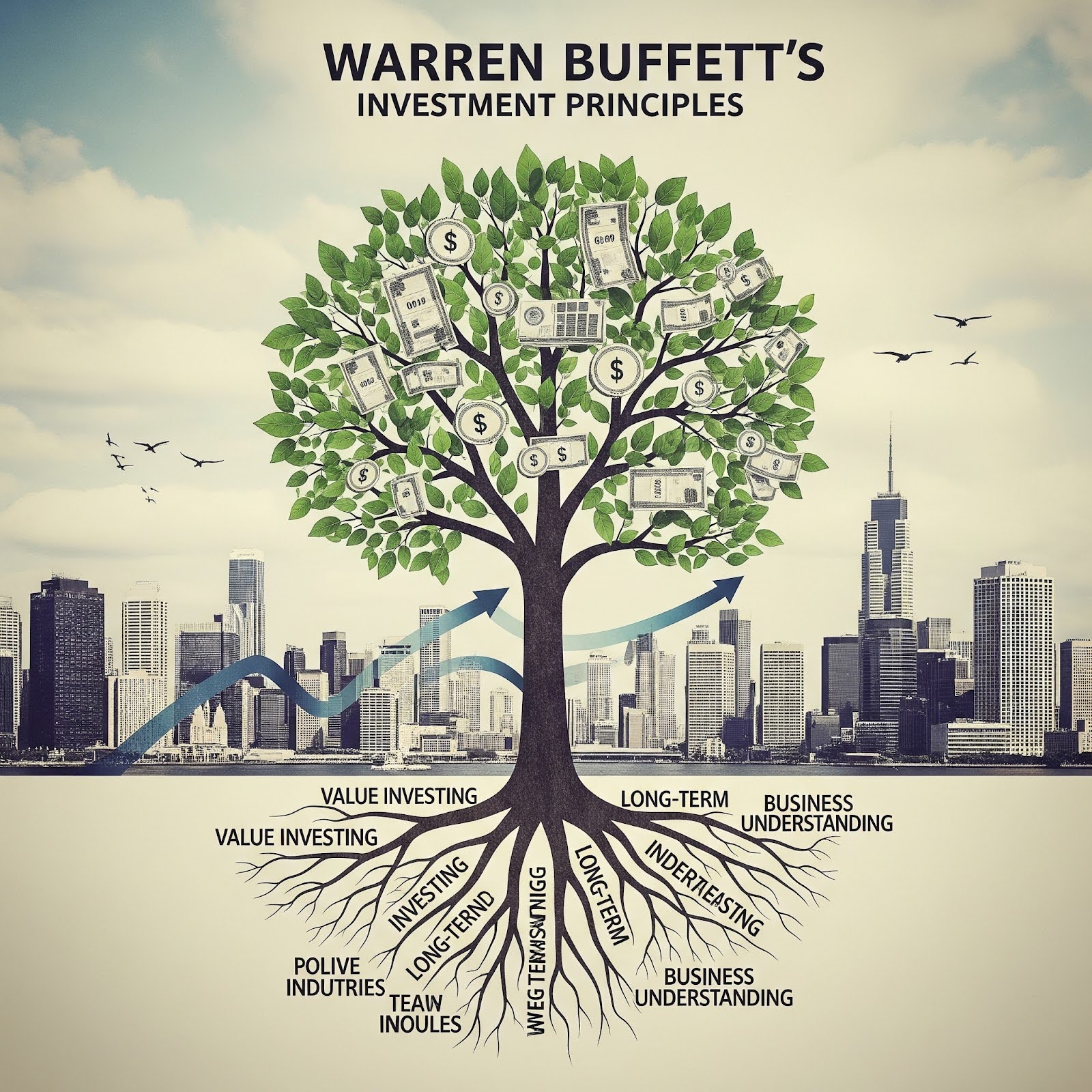
5. The quality of management: How to assess leaders when considering stock investing?
Buffett places enormous importance on the quality of a company's management team. He looks for honest, competent, and rational leaders who act in the best interests of shareholders. Good management can turn a good company into a great one, while poor management can ruin even the most promising business. When investing in stocks, evaluating the people at the helm is just as important as analyzing the numbers.
Look for managers with a clear vision, proven track record, and who treat shareholders' money as their own. This is a key factor for long-term success in stock investing.
How to apply Buffett's principles to your own stock investing?
Applying Warren Buffett's principles to your own stock investing isn't easy, but it's achievable. It requires patience, discipline, and a willingness to learn. Don't try to copy every one of his trades; instead, adopt his mindset and approach to the markets.
Start by building knowledge about the businesses and industries that interest you. This will help you define your circle of competence for stock investing.
Here are some practical steps you can take to integrate Buffett's wisdom into your stock investing strategy:
- Keep learning: Read annual reports, business books, and analyses. The more you know, the better decisions you'll make when investing in stocks;
- Be patient: Don't give in to market panic or euphoria. Good investment opportunities don't come every day. Wait for the right moment and price;
- Think like a business owner, not a speculator: When you buy a stock, you become a part-owner of the company. Focus on the business's long-term prospects;
- Avoid debt for investments: Buffett does not recommend using leverage for stock investing, as it significantly increases risk;
- Diversify wisely: Don't put all your eggs in one basket, but don't over-diversify to the point where your returns are diluted. Concentrate on your best stock investing ideas.
Remember, the goal is to buy wonderful companies at a fair price, not fair companies at a wonderful price. This is the essence of successful stock investing according to Buffett.
Common mistakes when trying to invest in stocks the Buffett way (and how to avoid them)
Despite the apparent simplicity of Buffett's principles, many investors fail to apply them. One of the main reasons is lack of patience. The market can remain irrational longer than you can remain solvent if you act hastily. In stock investing, emotions like fear and greed often override reason.
Another common mistake is stepping outside your circle of competence. It's tempting to invest in "hot" sectors even if you don't understand them. This often leads to poor decisions in stock investing. Paying too high a price, even for a quality company, also violates the margin of safety principle and can result in unsatisfactory returns. Finally, neglecting management quality can be fatal for your stock investing.
Avoiding these traps requires self-discipline and sticking to the core principles, even when it's hard.
To successfully apply these principles, especially when it comes to calculating intrinsic value and assessing competitive advantages, detailed stock analysis is an essential part of the process. This is where in-depth research of financial indicators and a company's market position becomes key. For your convenience, platforms like tradingtool.ai offer tools to analyze any stock in detail and support your investment decisions with data.
Conclusion: Buffett's wisdom as a guiding light for your stock investing
Warren Buffett's principles for investing in stocks are not a secret formula for getting rich quick. They are a philosophy for patiently, rationally, and knowledgeably building wealth through ownership in quality businesses. By focusing on understanding companies, seeking sustainable advantages, demanding a margin of safety, and maintaining a long-term horizon, you greatly increase your chances of success in the stock market.
His legacy in the world of stock investing is proof that common sense and discipline can lead to outstanding results. Feel the confidence that comes from knowing you're following in the footsteps of one of the greatest investors in history.
Are you ready to apply these timeless principles and transform your approach to stock investing? Start your journey today by researching companies you understand and seeking true value. Your future financial success may depend on it.
About the Author

Pavlin Marinov
Pavlin Marinov is part of the Trading Toolbox team, specializing in investment analysis and financial news. With years of experience in finance and investing, he strives to provide in-depth analysis and up-to-date market commentary. Through his publications and participation, he contributes to raising financial literacy and awareness among the audience.
Verified by

Gerasim Tsonev
Graduated in Computer Science from the University of Southampton with a passion for finance. As lead developer and CEO of Trading Toolbox, Gerasim ensures the accuracy and reliability of all published content.